Fourteen months ago, faced with a new and deadly virus, the world went home. Whole populations spent more than a year in quarantine. Quarantine, however, did not mean that everything stopped. We just began to do things differently. Case in point: the office workplace.
For the office, “differently” meant working from home. Overnight, those with smaller homes, found spaces to work in. Rooms in larger homes became offices. The furniture industry quickly developed comfortable and efficient products to support the home office. Technology, however, was the key to success for this different way of working.
Zoom and other similar platforms provided community and collaboration. The home office worker was no longer isolated. He or she also found that they didn’t need to adhere to a rigid work schedule. Technology was available 24 hours a day. The barking dog or noisy children became acceptable parts of the environment. Comfortable clothing took the place of accepted work attire. In fourteen months, the home office became a mainstream workplace facility.
At last, after fourteen months of quarantine, the world is waking up to a new normal. Various polls indicate that approximately 85% of the workforce is looking forward to returning to the office. Many companies are adopting hybrid work schedules that allow employees to split their workweek between the office and a remote location. The result is a reduction in corporate office size since less fulltime workstations are necessary. Some other companies are decentralizing their corporate offices and setting up satellite offices in what is referred to as a hub and spoke scheme.
Corporate office changes will have an impact on the shared workplace center model. Centers will become locations for rotating workforces that do not want to return to home offices. Conventional users that officed in centers prior to the pandemic will return to the shared environment. This group includes startup companies, remote workers, and independent consultants. A third group is the enterprise segment includes satellite locations. They began using centers prior to the onset of the pandemic. A fourth group consists of home office workers who do not want to return to the office environment but need its amenities and services.
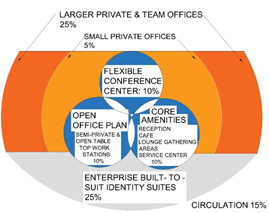
This growing and varied workforce will require a shared workplace model that can adapt and provide supportive working environments, choices, amenities, services, and technology that all four groups require. Individual and remote workers need choices of private, semi-private and open offices. Startup companies need choices of a variety of private office spaces. Sizes will range from two person to thirty-person team spaces. The enterprise group consists of specialized task forces that may be housed in as little as fifteen hundred dedicated square feet. Larger enterprise units and satellite locations may take full floors or possibly full buildings. All enterprise units are designed as individual units and constructed to client specifications. All four groups will have access to a flexible conference and event center with state-of-the-art equipment. In addition, a visually well-designed common gathering area that contains, a reception area, a comfortable lounge, community tables, a fully stocked café, and shared services will be available to all four groups.
The bubble plan below indicates the space size percentages and relationships of a shared workplace center that is described above. It is based on a 20,000 square foot floor plate.
 AoPlan'sblog